
For healthcare facilities, rehabilitation centers, and home care environments, the challenge of safe patient transfer is a constant priority. Manual lifting of individuals who have residual lower body strength but cannot stand independently poses significant risks for both the patient and the caregiver. Musculoskeletal injuries among nursing staff remain a leading cause of occupational illness, while patients face the danger of falls or improper handling. This is where the sit to stand lift becomes a transformative piece of equipment. These specialized devices are designed not to carry a patient, but to assist them. They work with the patient’s own weight-bearing ability, providing a secure pivot point and a gentle upward motion that facilitates a natural standing position. The market for these devices has expanded significantly as care standards shift toward patient dignity and caregiver safety. Understanding the nuances of these lifts—from their mechanical design to their therapeutic benefits—is critical for any purchasing decision. When you begin searching for a sit to stand lift for sale, you are investing in a system that promotes active patient participation in their own transfer. This is a stark contrast to a full-body sling lift, where the patient plays a passive role. The physical act of pulling oneself up from a seated position using the lift's handles helps maintain muscle mass, joint mobility, and cardiovascular circulation. Furthermore, these lifts are typically more compact and easier to maneuver than their ceiling-mounted or floor-based counterparts, making them ideal for tight spaces in standard bathrooms or bedrooms. The decision to acquire such a device must be based on a comprehensive understanding of patient needs, caregiver training requirements, and the specific features that distinguish a high-quality model from a basic one.
Key Features and Operational Mechanics of Modern Sit to Stand Lifts
To make an informed decision when evaluating a sit to stand lift, one must first understand the core components that define its function and safety. The primary mechanism is the lifting mast and actuator. Most modern units utilize an electric linear actuator powered by a rechargeable battery. This allows for smooth, controlled ascent and descent, which is crucial for patient comfort. The speed and responsiveness of this motor are not just convenience factors; they directly impact the user's sense of security. A jerky or noisy lift can startle a patient, causing them to tense up or lose their balance. Look for units with an emergency stop feature and a manual override mechanism. In the event of a power failure, a caregiver must be able to safely lower the patient using a crank or a simple hydraulic release. The base of the lift is equally critical. A wide-leg base provides the stability needed to support the dynamic nature of a standing transfer. As the patient shifts their weight and pulls themselves upright, the forces are not purely vertical. There is a lateral vector that can tip a poorly designed unit. Therefore, the base must be constructed of heavy-gauge steel and feature non-marring, lockable casters. The footprint should be narrow enough to fit under most beds and chairs but wide enough to provide a stable platform.
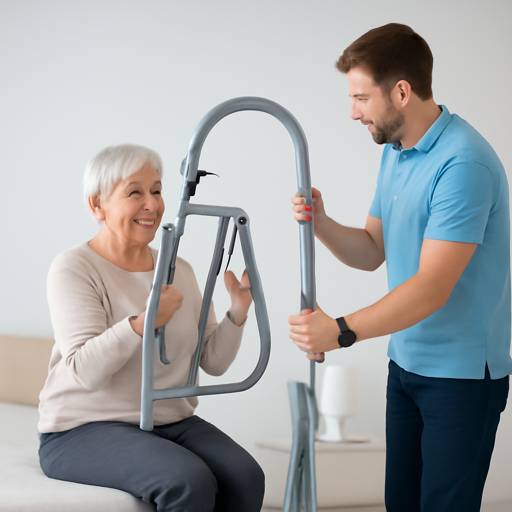
Another defining feature is the sling or support harness. Unlike full-body slings that go under the thighs and around the torso, sit to stand slings are designed to support the patient from the lower back and behind the knees. This design allows the patient's feet to remain on the floor or footplate, encouraging weight-bearing. The material of the sling is a major consideration. High-quality slings are made from breathable, washable, and rip-resistant polyester or nylon mesh. They should have multiple sizing options (small, medium, large, extra-large) and be easy to attach to the lift’s spreader bar. A poorly fitted sling can cause pressure points or allow the patient to slide. Additionally, the footplate must be adjustable for height and angle. A non-slip surface on the footplate is essential to prevent the patient’s feet from sliding during the lift. Many advanced models also include a knee pad. This may seem like a minor accessory, but it serves a dual purpose: it provides a tactile guide for the patient to know where to position their knees, and it acts as a stabilizer to prevent the patient from shifting forward during the lift. The control system, typically a hand-held pendant or a knee-operated toggle, should be intuitive. For a caregiver, the ability to control the lift while maintaining a steadying hand on the patient is non-negotiable. Therefore, a long, flexible control cable or a wireless remote is a feature worth prioritizing. Finally, evaluate the weight capacity. While many standard models handle up to 400–450 pounds, bariatric versions are available for higher capacities. Do not guess on this; a lift used near its maximum load will perform poorly and may be unsafe. The motor strain and hydraulic force required near the upper limit can lead to premature wear or a catastrophic failure. Always choose a lift with a capacity rating comfortably above the heaviest patient you intend to transfer.
Clinical Case Studies and Real-World Impact of Sit to Stand Technology
The theoretical benefits of a sit to stand lift are universally acknowledged, but real-world case studies provide the most compelling evidence for their adoption. Consider a 180-bed skilled nursing facility in the Midwest that struggled with a high rate of workplace injuries. For years, they relied on manual two-person assisted stands for residents who were "fall risks." The facility's injury log showed a consistent pattern of back and shoulder strains among nursing assistants. In 2022, they implemented a facility-wide policy requiring the use of a sit to stand lift for any patient who scored below a 4 on the “ability to stand without assistance” scale. Within nine months, the facility reported a 73% reduction in staff musculoskeletal injuries. However, the most surprising outcome was not the staff safety metrics. The physical therapists noted that residents who were hesitant to participate in standing exercises became more willing. The lift provided a “safety net” that reduced their fear of falling. One patient, an 85-year-old woman recovering from a hip fracture, had refused all standing attempts for three weeks. Once introduced to a sit to stand lift, she began standing daily. Within a month, her sit-to-stand strength improved by 40%, measured by a functional reach test. This case illustrates that the device is not just a safety tool; it is a therapeutic instrument that facilitates recovery.
Another powerful example comes from home healthcare. A family in a suburban environment was caring for their father, a 78-year-old veteran with Parkinson’s disease. His ability to stand had deteriorated, but he still had enough strength to support himself if given a stable assist. The family initially avoided a mechanical lift, believing it was a sign of total dependence. After a near-fall where the son strained his back, they purchased a sit to stand lift. The difference was immediate. The father regained a sense of agency; he was no longer being “lifted” but rather “assisted” to stand. This psychological shift was profound. The device allowed him to participate in transfers to his recliner and the toilet, maintaining his dignity and reducing the need for incontinence products. The case study here is not just about the physical transfer—it is about preserving the individual’s sense of self. The device allowed him to live at home for an additional 18 months before requiring a higher level of care. In contrast, a comparison case where a family used only full-body lifts and manual assistance showed accelerated muscle atrophy and a faster decline in the patient's overall condition. The key takeaway from these examples is that the application of a sit to stand lift directly correlates with better patient outcomes when the patient retains some lower-extremity strength. The lift actively combats the "deconditioning syndrome" common in institutionalized and homebound elderly populations. It maintains the neuromuscular pathways required for standing, which is a prerequisite for walking. For healthcare administrators, these case studies translate into concrete return on investment. Fewer injuries mean lower workers' compensation premiums, less overtime to cover injured staff, and reduced turnover. For patients, it means a higher quality of life, increased independence, and a slower trajectory of physical decline. These are not abstract metrics; they are the daily reality for facilities that have integrated this technology correctly.
